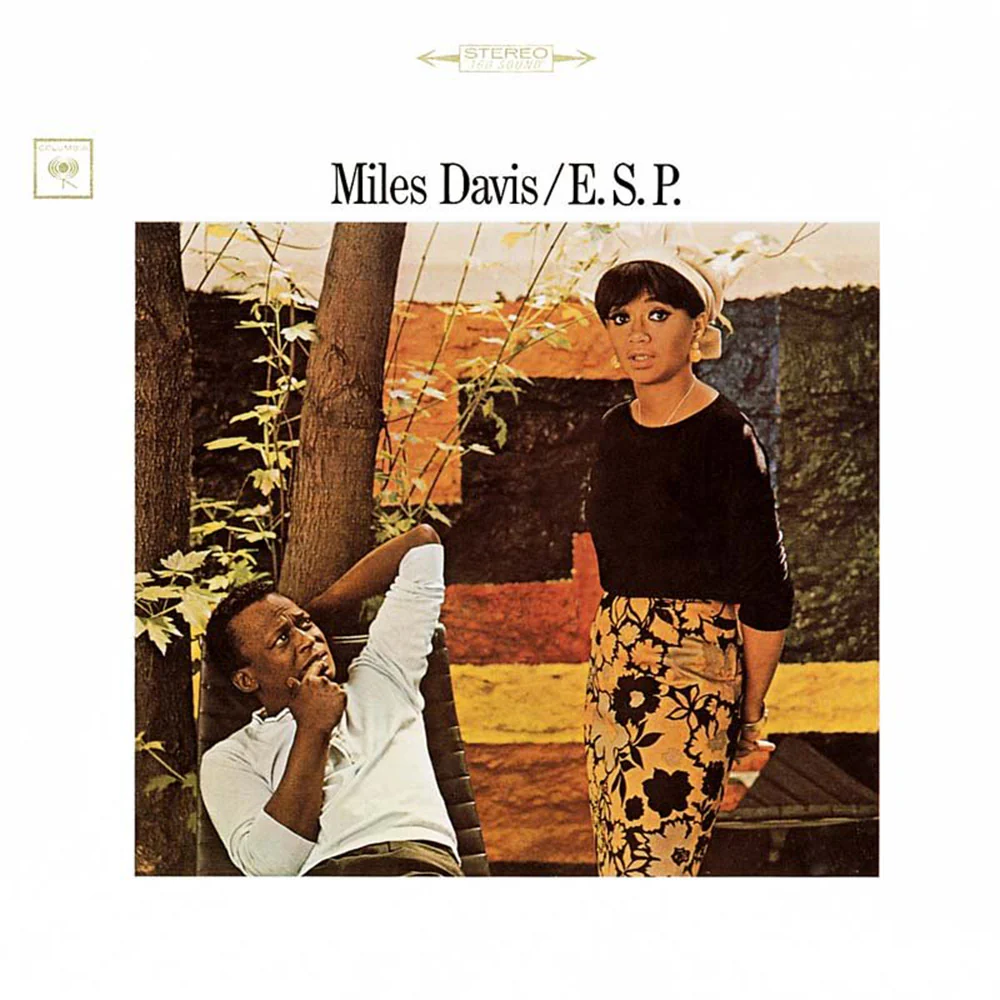
Miles Davis - E.S.P.
Unlike the majority of previous Davis albums, E.S.P. consisted entirely of new compositions written by members of the group. Despite the profusion of new material, only one tune (“Agitation”) is known to have appeared in the group’s live performances. “Little One” might be best known for being revisited on Hancock’s landmark album, Maiden Voyage, recorded a few weeks later. This version is somewhat more embryonic; Carter’s bass is halting, and Davis and Shorter state the theme with winding, interlocking contrapuntal lines that evoke Davis and Coltrane’s version of “Round Midnight”. Hancock’s solo on Carter’s composition, “Eighty-One”, also presages his work on that LP – particularly its title track.
The title track is reminiscent of Jackie McLean’s “Little Melonae”, which Davis had recorded with John Coltrane in 1956. “Iris”, by contrast, is another Coltrane-like ballad, not too dissimilar to “Infant Eyes” on Shorter’s Speak No Evil album. Shortly thereafter, Shorter’s compositions would begin to dominate the Quintet’s recordings, though here he contributes only two of the seven songs.
This was the first time Wayne Shorter recorded with Miles, and the band – in this configuration – had been together for less than a year. As you will hear, the connection between the musicians is uncanny, as if they had been playing together for decades. Especially notice Wayne Shorter’s brilliant interplay with Miles on the closing track “Mood,” the haunting ballad written by bassist Ron Carter. At over forty-eight minutes, E.S.P. is one of the longest jazz albums of its period.
Unlike the majority of previous Davis albums, E.S.P. consisted entirely of new compositions written by members of the group. Despite the profusion of new material, only one tune (“Agitation”) is known to have appeared in the group’s live performances. “Little One” might be best known for being revisited on Hancock’s landmark album, Maiden Voyage, recorded a few weeks later. This version is somewhat more embryonic; Carter’s bass is halting, and Davis and Shorter state the theme with winding, interlocking contrapuntal lines that evoke Davis and Coltrane’s version of “Round Midnight”. Hancock’s solo on Carter’s composition, “Eighty-One”, also presages his work on that LP – particularly its title track.
The title track is reminiscent of Jackie McLean’s “Little Melonae”, which Davis had recorded with John Coltrane in 1956. “Iris”, by contrast, is another Coltrane-like ballad, not too dissimilar to “Infant Eyes” on Shorter’s Speak No Evil album. Shortly thereafter, Shorter’s compositions would begin to dominate the Quintet’s recordings, though here he contributes only two of the seven songs.
This was the first time Wayne Shorter recorded with Miles, and the band – in this configuration – had been together for less than a year. As you will hear, the connection between the musicians is uncanny, as if they had been playing together for decades. Especially notice Wayne Shorter’s brilliant interplay with Miles on the closing track “Mood,” the haunting ballad written by bassist Ron Carter. At over forty-eight minutes, E.S.P. is one of the longest jazz albums of its period.
Original: $94.88
-65%$94.88
$33.21Description
Unlike the majority of previous Davis albums, E.S.P. consisted entirely of new compositions written by members of the group. Despite the profusion of new material, only one tune (“Agitation”) is known to have appeared in the group’s live performances. “Little One” might be best known for being revisited on Hancock’s landmark album, Maiden Voyage, recorded a few weeks later. This version is somewhat more embryonic; Carter’s bass is halting, and Davis and Shorter state the theme with winding, interlocking contrapuntal lines that evoke Davis and Coltrane’s version of “Round Midnight”. Hancock’s solo on Carter’s composition, “Eighty-One”, also presages his work on that LP – particularly its title track.
The title track is reminiscent of Jackie McLean’s “Little Melonae”, which Davis had recorded with John Coltrane in 1956. “Iris”, by contrast, is another Coltrane-like ballad, not too dissimilar to “Infant Eyes” on Shorter’s Speak No Evil album. Shortly thereafter, Shorter’s compositions would begin to dominate the Quintet’s recordings, though here he contributes only two of the seven songs.
This was the first time Wayne Shorter recorded with Miles, and the band – in this configuration – had been together for less than a year. As you will hear, the connection between the musicians is uncanny, as if they had been playing together for decades. Especially notice Wayne Shorter’s brilliant interplay with Miles on the closing track “Mood,” the haunting ballad written by bassist Ron Carter. At over forty-eight minutes, E.S.P. is one of the longest jazz albums of its period.